
Little Red Riding Hood
Solo Student Level and Quest Design Project at DigiPen Institute of Technology
Roles: Level Designer, Encounter Designer, Mission / Quest Designer.
Tools: Unreal Editor for Fortnite, Figma, Microsoft Word.
Skills: Level Design, Encounter Design, Environmental Storytelling, Design Iteration, Technical Level Design, Cinematics, Playtesting.
Genre: Third-Person, Action, Adventure.
Target Audience: Players driven by immersion and role-playing, particularly within a Western Action RPG style presentation.
Designing for Quests
Levels in many games exist as part of a larger overarching story. They serve as both the space for gameplay to occur, but also as a device for a game's story and theme's to be explored through, which weave moments together, and fit both with respect to what came before them and set up what is to come after. For this project, I designed three levels which observe the overarching storyline of Little Red Riding Hood. Each level explores a different type of quest to help convey the narrative, and each leads directly into the next level's content. Below, you can learn about how I designed each level.

Combat Mission
Creating Stealth Action Scenarios with Fortnite's Tools

Pre - Production Planning
This project was completed as part of a class at DigiPen Institute of Technology. Each level was completed back to back over the course of a three month period, spending a month on each level. The Combat Mission was the first of these level.
For this project, specific instructions, the story and dialogue, and quest objectives were provided, and so my work began for each level by considering the specifications and requirements of the content. With these thoughts in mind, I then sketched a top down map design on paper.
One of the considerations when drawing out the map of the space was how I would work combat encounters into the design, and how I would also break up things like traversal with environmental challenges and puzzles.
Where dialogues and other character interactions were also very important in this case, and especially so for this level, as this first level introduces character's and establishes the core gameplay loop that will occur over the next several maps.
As this project was being developed using UEFN (Unreal Editor for Fortnite), I had a fairly vast toolset of gameplay options at my disposal. As a fan of Metal Gear Solid, where I could, I used the the gameplay tools on option to largely develop stealth focused encounters.
In practice, creating stealth encounters with Fortnite's gameplay challenged me to focus on carefully designing scenarios that would severely punish the player for rushing into combat blindly. Instead, cover would be placed carefully to direct sight lines, and provide cover as the player sneaks through the space attempting to take out enemies one at a time, ideally before the enemy sees them.
To the right is the top down sketch I would use to start blocking out the space in UEFN, but you might notice it looks pretty minimalist and cleanly drawn. That's because it's actually a redrawn version that's purposely easier to read.
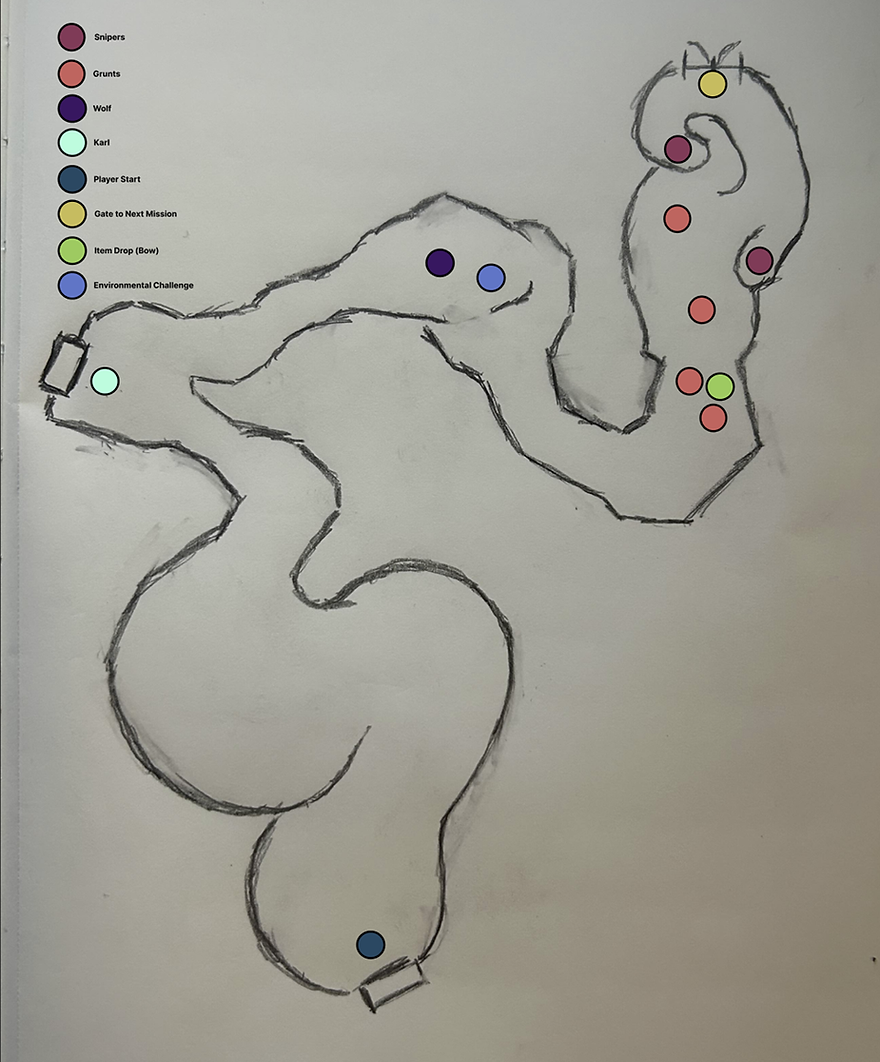
The actual first sketch looked like this.

From the top down map, I then broke down the exact flow of the level. This was done based on the narrative notes for the level, including things like when and where cutscene's should occur, what NPC's are in the level and when does the player interact with them, when are the combat encounters supposed to occur relative to the more explicit story moments, and so on.
Then from the flow map, which you can see to the right, I outlined a timeline and challenge curve, both to help me consider pacing, and to help me better plan encounter challenge for combat scenarios in the space.
One important note about this level is that I had a limitation to ensure the level was designed around fitting within a 5 to 7 minute average playtime (with some variability depending on the player).
Based on the timeline I illustrated, I actually was under the intended duration, and based on that, I decided to add an additional section to the encounter at the end of the level.

I then sketched out this new area to the space, and in this case also identifying an opportunity to create an interesting scene composition and backtracking moment utilizing keys, windows, and ziplines.

In Engine Production
Jumping into UEFN, I used my top down maps as reference to build the space using a mix of the landscaping tool and environmental props. Once the space was taking shape, I then added encounters and set dressing, making constant tweaks based on playtesting.
As the focus of this first quest is about stealth combat, I designed spaces to allow the player to take their time, and examine their surroundings before immediately being ambushed by enemies.
This allows the player to learn where enemies are, how they behave or move, and even pick off easy targets before being noticed.
The environment comes to a point looking up at the tower behind this red target which a few enemies were previously guarding.
This is done so when the player hits the target with their sword (which they learned to do earlier in the level), the player is standing in a position where they will immediately see the results of their actions, as the door to the tower opens.
At the top of this tower, the player will find a key to a door that was locked earlier in the level.
When the player position's their character to pick up the key, the window behind it frames the exact door the player needs to open, reminding the player of the objective, and showing them exactly where they need to get to.
Next to the key is a zipline going back down close to where the locked door is. This creates a one way traversal path that both makes for interesting backtracking, and a satisfying final moment.
The environment is set dressed with props that give warm and homey vibes.
This is done to establish an emotional reaction and invoke an attachment to the space from the player. This helps reinforce the storyline of the quest for why the protagonist cares when people of the town go missing alongside the rise of mysterious otherworldly monsters.
Using Cinematics to Help with Guidance
When the protagonist's mother describes the objective of the level, the camera moves to show the path to where the player will need to go.
At the end of the cutscene, the final camera shot points to and frames the immediate direction the player will need to go in.
Some Challenges with UEFN
As UEFN requires levels to be built and played in the separate Fortnite
application anytime a developer might want to test changes, it can be very time consuming and difficult to have a consistent idea of player scale within a project.
A mistake I made on this level was underestimating how impactful this would be on my workflow, and as a result some traversals are too long to stay engaging. If there is one change I would make about this level with more time, it would be cutting down these traversal durations.
However, I did learn a valuable lesson from this mistake, and both subsequent levels improve in this regard.
Originally, these red targets were intended to be shot with the newly acquired bow at a distance by the player.
While implementing the feature, I learned UEFN's arrows weren't considered as detectible for triggering events without Verse code.
To solve this, in the interest of time, I moved the targets to places where the player could hit them with melee strikes instead, which we're detectable out of the box without Verse code.
Full Level Playthrough
Fetch Mission
Using Fortnite's Tools to get Lost in the Fog

Pre - Production Planning
Much the same as the first map, quest 2 was completed in a month long period, rigorously abiding to providing story details.
In this level, the player has followed the monsters from the previous level deep into a mysterious forest. Here, they will meet the antagonist character, and be tasked with tracking down a series of collectables in order appease said antagonist character.
That is to say, if the first level was primarily focused on combat, this level is primarily focused on item collection.
In my first level I took loose inspiration from Metal Gear Solid, and in this level, I took similar loose influence from Silent Hill and Resident Evil 4 (2023).
Aside from aesthetic similarities given the more spooky environment, a goal for me in designing this space was to create encounters where the player might prefer to try and escape rather than defeat every enemy. Similar to survival horror titles, resource management and overwhelming amounts of enemies could be used to keep the player on the run, which I though would provide a unique experience.
Subtly, some stealth elements would carry over from the previous level as well to provide another option for the player to circumvent the overwhelming odds, however, not every encounter would invite this play style, thus prompting the player to think on their feet.
I also wanted to create a massive lake, which could be traversed by unlocking a boat, inspired by the village portion of the remake of Resident Evil 4.

Above, you can see the top down map I sketched to base my blockout on.

As you can gather from the top down sketch, this second level is much larger than the first level was, but as you can see from the level flow diagram I created for this level, the size isn't just recognized in the scale of the environment, but also in the amount of tasks the player actually has to do to get from beginning to end in the level.

Likewise, this larger scale when timed out then also results in a longer overall level duration. For this level, my intended time frame was around 8 minutes for the average playthrough.
In Engine Production
Based on my Pre-Production Designs, I moved back in UEFN to start building the level.
The Flower Beds a Purple Magic draw the player towards the final Collectable in the Level, which triggers a large enemy encounter.
Across the Lake, the Player can see a faint light shining in the distance, but they have no means of crossing the Lake.
When the player enters that heavily guarded area, the Scene Composition immediately let's the player see the Key in the top right, Pointed to by the Strange Purple Rock.
The Pink Teddy Bear Clashes with the environment, is Scaled Up, and Set Under a Point Light all to draw the player's attention to it. There the player can learn more about the what's happened to a character in the story.
After the player explores this heavily guarded area of the forest, they acquire this Key, which upon picking it up reveals that there is now a boat which they can use to cross the Lake.

Here's how the exact Composition Frame Looks.
Using Cinematics to Help with Guidance
The cutscene points out the direction the player should go in, and the camera is scripted to face the same direction when the cutscene ends.
When the player triggers the gate to open, a quick cutscene is shown to both add satisfaction to the action, and show the player exactly what they did.
Development Challenges
For this level, one of the things I was really excited about was creating a striking atmospheric fog effect, reminiscent of the Silent Hill series.
Creating the look of my levels fog was complicated, with many of the effects involved completely breaking in the editor viewport, or failing to load and unload when called to.
These elements combined made creating the look quite time consuming, since I could never tell for sure from the editor how it would actually look in game.
Eventually though, I was able to get the look I wanted, however even then, Fortnite's Graphic's Scaling could make what looked correct from my computer completely unplayable from another, which isn't a problem I've normally have had to consider while doing level design work.
This is how the Lake Section of this Level looked from my Computer.

And this is how the same Lake Section looked from a different computer.
A lesson I learned from developing the fog is to consider back up plans if an editors tool set isn't able to support the needs of the game design.
As a level designer, it's important to work towards achieving a Minimum Viable Product (MVP) as quickly as possible. Between the scale of the level and the fog effect, achieving this became quite difficult, because even though building the space and encounters didn't take all that long, as the fog was significant to the experience and impacted gameplay at several select points, without it working, the level couldn't reach it's MVP state.
I was able to make my level work by continuing to experiment with different combinations of fog effects and triggers, but a smarter solution may have been to start with a simpler design concept, or design my content so the fog wasn't a necessary component.
This kind of discipline can be tough as a designer, but it is more time efficient for achieving a MVP version of a level faster.
Full Level Playthrough
Escort Mission
Designing a Space for more than just the Player

Pre - Production Planning
Just as with the two previous levels, the final level of this project was completed in a month long period, and based off of provided narrative direction documenetation.
This final quest of the level is an Escort Mission, where the player isn't just responsible for themselves reaching the end of the level, but they are also responsible for protecting an NPC character through the level.
Coming out of the previous level, I was driven to creating something smaller in scale, and simpler in technical scope, which complimented the narrative notes provide nicely.
This level had to abide by a strict 5 Minute time limit, and a timer would exist in game to trigger a fail state if the player couldn't reach the end in that amount of time.
The scenario described a more abstract setting than the previous levels, which were comparatively more grounded. Likewise, the setting was meant to feel unstable, and as if it were falling apart, hence the purpose of the time limit to complete the level.
To the right is the top down sketch I would use to start blocking out the space in UEFN.
Once in Engine, I actually stripped down the level further, and this was for two reasons:
-
A tighter spatial design would maintain more action for a greater amount of the level, which was more engaging for a level which in a lot of ways was just about traversing from point A to B.
-
Making the space go to fewer areas meant there were fewer areas of the environment that I would need to set dress to reach a consistent visual fidelity across the level.


Based on the Top-Down Map, I created this Level Flow Chart which illustrated each of the things the Player would do in the level. As you can see, this level was comparatively much simpler than the previous two, with a lot more scripted cinematic elements in place of gameplay.


